Tree Removal services by qualified staff for safe removal of trees of any size.
Tree Pruning services to enhance tree health, aesthetics, and property safety.
Tree Lopping, Cutting, and Removal for large or hazardous branches and trees.
Palm Tree Removal including stumps, fronds, leaves, seeds, and fruit.
Hedge Pruning for neat, attractive, and safe hedge growth.
Land Clearing for residential, commercial, and agricultural areas, including large-scale projects.
Block and Land Clearing for property preparation, construction, or landscaping.
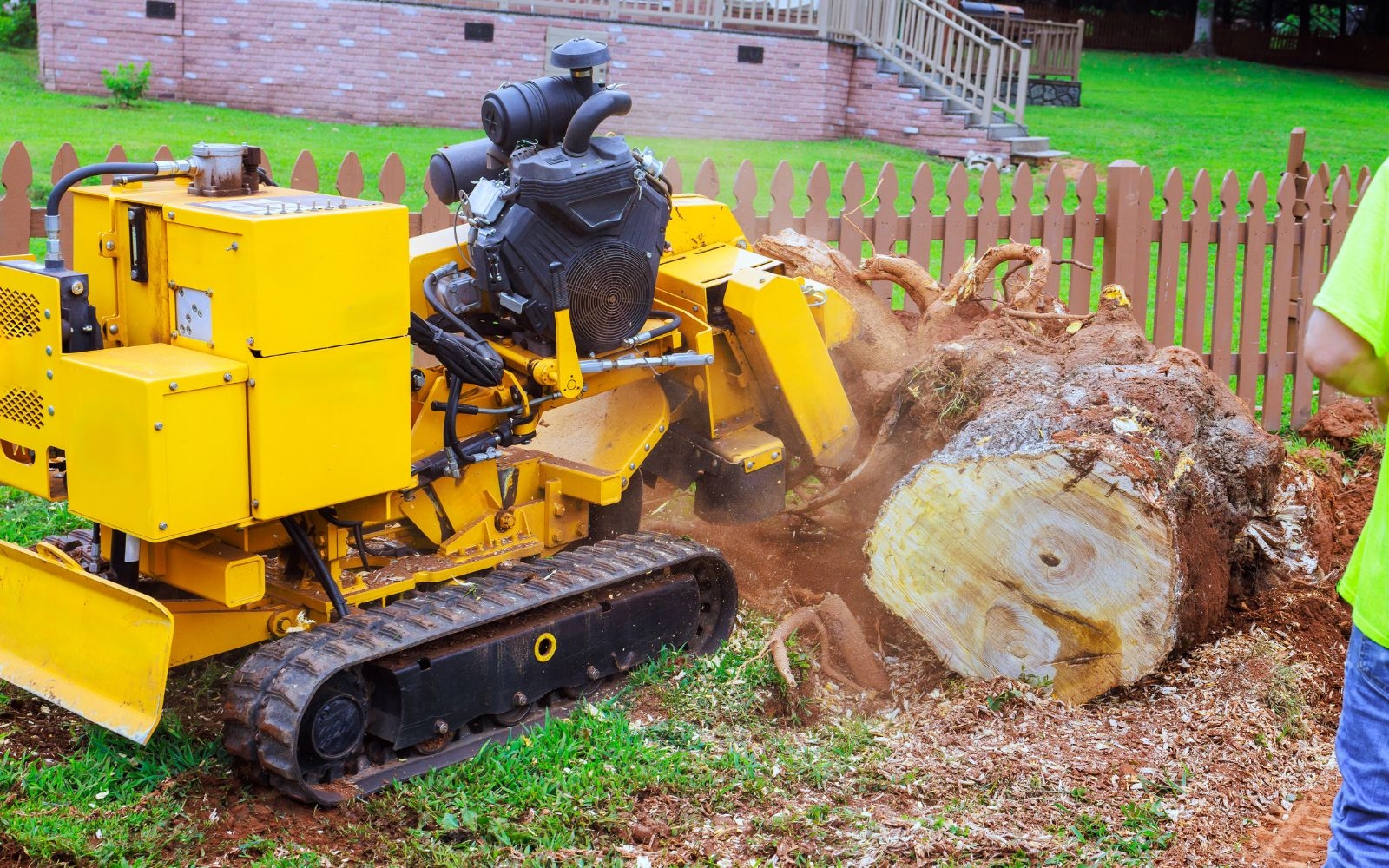
Stump Grinding with modern machinery to remove all traces of tree stumps.
Commitment to protecting property and surrounding areas during tree services.
Trusted location at Unit 9/169 Beavers Rd, Northcote VIC 3070, serving Melbourne homeowners and businesses.
Use of modern, high-quality equipment and safety gear for all tree care operations.
Comprehensive insurance coverage for all services, ensuring client peace of mind.
Identification of hazards including overgrown branches, storm damage, proximity to cables, and invasive roots.
Professional handling of pest infestations and excessive or misdirected tree growth.
Efficient, experienced, and results-driven service for timely project completion.
Storm-related tree damage is a significant concern for both urban and rural communities, impacting not only the aesthetic value of landscapes but also posing potential hazards to public safety and property. High winds, heavy rain, and lightning are among the primary culprits that can lead to a variety of damage types, including broken branches, split trunks, and uprooted trees. These damages can weaken the structural integrity of trees, increasing the risk of falling limbs or entire trees, especially during subsequent storms.
Key Impacts of Storm Damage:
The implications of storm damage extend beyond immediate safety hazards. Damaged trees can disrupt power lines, hinder transportation, and require substantial resources for cleanup and restoration efforts. Additionally, the loss of mature trees can have long-term ecological impacts, such as reduced carbon sequestration, decreased habitat for wildlife, and diminished shade, which can affect local microclimates.
For property owners, understanding the extent and nature of storm damage is crucial for taking appropriate action. This includes assessing whether a tree can be salvaged through professional pruning and care or if it poses a significant enough risk to necessitate removal. Melbourne Tree Removal Experts is a trusted provider of professional tree services across Melbourne and surrounding suburbs. With a qualified and experienced team, we specialise in safe, efficient and affordable solutions for all types of tree care needs. Whether you require complete tree removal, detailed pruning, hedge shaping or large-scale land clearing, our experts are equipped with modern machinery and industry-standard safety gear to deliver outstanding results. Melbourne Tree Removal Experts Our comprehensive service range includes tree removal for trees of any size or condition, ensuring the safety of your property and the surrounding environment. We also offer expert tree pruning to improve tree health, encourage strong growth and enhance the overall appearance of your landscape. For properties that require extensive preparation, our land-clearing services cover residential, commercial and agricultural sites. We have the heavy-duty equipment needed for larger projects, from clearing shrubs to removing mature trees.. Furthermore, recognizing the signs of damage early can help prevent future incidents and inform decisions about planting more resilient tree species in vulnerable areas.
Communities and municipalities must also consider the broader implications of storm damage on urban forestry management and emergency response planning. By investing in proactive measures, such as regular tree maintenance and the strategic planting of wind-resistant species, the long-term impacts of storm-related damage can be mitigated, ensuring safer and more resilient environments for all.
One of the most evident signs of storm damage in trees is broken branches. These can vary from small twigs to large limbs that have snapped under the force of high winds or heavy rain. It's crucial to assess the size and location of the breakage, as larger branches can pose a risk to people and property below. Additionally, broken branches can create open wounds on the tree, making it vulnerable to disease and pest infestations. Regularly inspecting and removing broken branches can help maintain the tree's health and safety.
After a storm, you may notice that some trees have started to lean. This can be a sign that the root system has been compromised, possibly due to saturated soil or strong winds. A leaning trunk can indicate that the tree is unstable and at risk of falling, which poses a significant danger. It's essential to evaluate the extent of the leaning and consider professional assessment if necessary. Early detection and intervention can prevent further damage and potential hazards.
Storms can cause significant damage to the bark of a tree, which is often an overlooked indicator of distress. Bark that is cracked, stripped, or gouged can expose the inner layers of the tree to harmful elements. This damage can disrupt the tree's ability to transport nutrients and water, affecting its overall health. Inspecting the trunk and major branches for bark damage after a storm is essential for early detection and treatment. Prompt action can help prevent further decline and preserve the tree's vitality.
Severe storms can lead to root exposure, which is a critical sign of potential damage to a tree. High winds and flooding can erode the soil around the base of the tree, exposing roots that are normally underground. This exposure can weaken the tree's stability and its ability to absorb nutrients effectively. It's important to address any exposed roots by covering them with soil or mulch to protect them from further damage. Monitoring the tree for signs of stress, such as wilting leaves, can also help in assessing the impact of the exposure.
Another subtle indicator of storm damage is leaf discoloration. After a storm, leaves may turn yellow, brown, or show signs of wilting, which can signal stress or damage to the tree. This discoloration can result from physical damage to the tree's structure or root system, affecting its ability to take up water and nutrients. Regularly observing the foliage for changes in color or texture can provide early clues to underlying issues. Addressing these symptoms promptly can help in mitigating long-term damage and supporting the tree's recovery.
Assessing tree damage after a storm is a crucial step in ensuring safety and maintaining the health of an urban forest. Various tools and methods can assist arborists and forestry professionals in evaluating the extent of damage effectively. One of the primary tools used is the resistograph, a device that measures the resistance of wood to a fine drill bit, providing insights into the internal integrity of the tree. This tool is particularly useful for detecting decay or hollow areas that are not visible externally.
Digital tools have also become invaluable in storm damage assessment. Geographic Information Systems (GIS) and remote sensing technologies allow for the mapping and analysis of large areas, providing a broader perspective on the impact of a storm. These technologies can help prioritize areas for immediate attention, making the assessment process more efficient.
Another essential method is visual inspection, which involves a comprehensive examination of the tree's structure, including the trunk, branches, and root systems. Trained professionals look for signs of damage such as cracks, leaning, or broken limbs. This process often includes the use of binoculars for a detailed view of higher branches and aerial inspections using drones, which can capture images from angles otherwise inaccessible.
Additionally, the use of mobile applications has streamlined data collection and sharing. Arborists can record observations, take photographs, and upload data in real-time, facilitating faster decision-making and resource allocation. By leveraging these tools and techniques, professionals can assess storm damage more accurately, ensuring timely intervention and management of affected trees.
Proper documentation and reporting of tree damage are essential steps in securing insurance claims or planning restoration efforts. Begin by thoroughly inspecting the affected area. Take clear, high-resolution photographs from multiple angles to capture the extent of the damage. Include wide shots to show the tree's overall condition and close-ups to highlight specific issues such as broken branches, split trunks, or uprooted roots. Use a measuring tape or another object for scale in your photos to provide context for the size of the damage.
Key Steps in Documentation:
Next, create a detailed written report. Start with basic information: the date and time of the incident, the tree species, and its location. Describe the observed damage in detail, noting any immediate hazards such as hanging branches or leaning trees. If possible, identify potential causes of the damage, such as high winds or lightning strikes. Include any relevant weather reports or eyewitness accounts to support your observations.
For insurance purposes, gather documentation of the tree's pre-damage condition. This could include previous photographs, maintenance records, or arborist assessments. If restoration is your goal, consult a certified arborist to evaluate the tree's health and viability for recovery. Their professional assessment can provide critical insights and support your case for insurance claims or restoration grants.
Finally, organize all documentation into a comprehensive report. Include your photographs, written observations, and any expert evaluations. Submit this report promptly to your insurance provider or relevant authorities, ensuring you comply with any specific reporting requirements they may have. Proper documentation not only facilitates smoother claims processing but also aids in the effective restoration and management of damaged trees.
When trees are compromised by storm damage, it is crucial to implement strategies that prevent further harm and mitigate potential risks. One effective approach is to conduct a thorough assessment of the affected area to identify trees that pose immediate threats. This involves inspecting for signs of structural weakness, such as cracks in the trunk or large limbs that are hanging precariously. Engaging with a certified arborist can provide expert insights into the stability of the trees and recommendations for necessary interventions.
Key Strategies for Risk Mitigation:
Pruning is a common method to alleviate potential hazards. By removing broken or dead branches, the risk of them falling and causing damage is significantly reduced. In some cases, more extensive pruning may be required to restore the tree's balance and health. It is essential to ensure that pruning is done correctly to avoid further stress to the tree.
In situations where a tree is severely damaged and poses an imminent threat to property or safety, removal might be the best option. While this is a last resort, it is sometimes necessary to prevent accidents and allow space for new growth. Planting replacement trees can help restore the environmental benefits that the removed tree provided.
Preventive measures should also be considered to protect trees from future storms. This includes regular maintenance, such as routine inspections and pruning, to enhance tree resilience. Additionally, selecting appropriate species for the local climate and soil conditions can contribute to the long-term health and stability of trees.
Overall, a proactive approach to managing storm-damaged trees not only reduces immediate risks but also fosters a healthier, safer environment in the long run.
When storms cause destruction, trees often suffer the most damage, posing risks to property and safety. In these situations, the expertise of arborists becomes essential. These trained professionals specialize in assessing tree health and stability, offering crucial insights beyond what the untrained eye can perceive. Arborists can identify structural weaknesses, potential hazards, and the extent of damage that may not be immediately visible. Their expertise ensures that decisions regarding tree removal, pruning, or preservation are made with precision and care.
Engaging professional services for storm-damaged trees is not just about immediate safety; it is also about long-term tree health and landscape aesthetics. Arborists can recommend appropriate interventions, such as cabling or bracing, to support trees that can be salvaged, thus preserving the canopy and maintaining the ecological balance. Moreover, they adhere to industry standards and safety protocols, significantly reducing the risk of injury or further property damage during the remediation process.
Additionally, arborists provide valuable advice on preventative measures to minimize future storm damage. This includes selecting suitable tree species for specific environments, strategic planting to optimize wind resistance, and regular maintenance practices to enhance tree resilience. By investing in professional arborist services, property owners not only safeguard their immediate surroundings but also contribute to a healthier and more sustainable urban forest.
In conclusion, while storm damage can be overwhelming, the guidance and skills of arborists play a pivotal role in managing the aftermath efficiently and effectively. Their involvement ensures that trees are preserved where possible, removed when necessary, and that landscapes are restored with both safety and sustainability in mind.
To protect trees from the potential damage of future storms, implementing preventative measures and preparations is essential. One of the most effective strategies is regular tree maintenance, which includes pruning to remove dead or weak branches that may break easily during high winds. Proper pruning not only enhances the tree's structural integrity but also promotes healthier growth.
Another crucial step is assessing the tree's health and stability. This involves checking for signs of disease, decay, or root issues that could compromise the tree's ability to withstand storm conditions. Employing a certified arborist to conduct a professional evaluation can provide valuable insights into the necessary interventions to strengthen the tree's resilience.
Strategic placement of trees is also vital in minimizing damage. When planting new trees, consider the species' wind resistance and choose locations that minimize exposure to prevailing winds. Additionally, ensuring adequate spacing between trees can prevent them from causing damage to each other during storms.
In areas prone to severe weather, investing in protective measures like cabling and bracing can be beneficial. These techniques involve installing flexible cables or rigid rods to support weak branches or limbs, reducing the risk of breakage.
Finally, educating the community about the importance of tree care can foster a collective effort in maintaining healthy urban forests. Workshops or informational sessions can equip homeowners and property managers with the knowledge needed to take proactive steps in protecting their trees against storm damage.
By adopting these preventative strategies, the likelihood of significant storm damage can be greatly reduced, preserving the beauty and benefits that trees provide to the environment and the community.


|
Melbourne
Naarm (Woiwurrung)
Naarm (Boonwurrung) |
|
|---|---|
|
City
|
|
|
Melbourne skyline and Kings Domain
Flinders Street Station
Shrine of Remembrance
Melbourne Cricket Ground
Royal Exhibition Building
Melbourne CBD and Princes Bridge
|
|
Melbourne
|

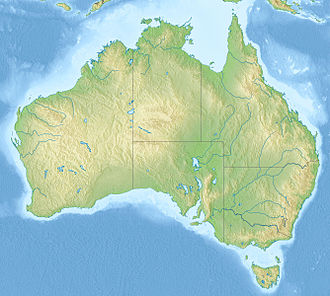
Coordinates: 37°48′51″S 144°57′47″E / 37.81417°S 144.96306°ECountryAustraliaStateVictoriaLGA
Location
Established30 August 1835Government
• State electorate
• Federal division
Area
2,453 km2 (947 sq mi)Elevation
31 m (102 ft)DemonymMelburnianPopulation
• Total5,350,705 (2024)[7] (2nd) • Density535.5/km2 (1,387/sq mi)Time zoneUTC+10 (AEST) • Summer (DST)UTC+11 (AEDT)CountyBourke, Evelyn, Grant, MorningtonMean max temp20.2 °C (68.4 °F)Mean min temp9.7 °C (49.5 °F)Annual rainfall515.5 mm (20.30 in)
| Localities around Melbourne | ||
| Loddon Mallee | Hume | Hume |
| Grampians | Melbourne | Gippsland |
| Barwon South West | Port Phillip Bay | Gippsland |
Melbourne is the capital and most populous city of the Australian state of Victoria, and the second most-populous city in Australia, after Sydney.[7] The city's name generally refers to a 2,453-square-kilometre (947 sq mi) area,[8] comprising an urban agglomeration of 31 local government areas.[9] The name is also used to specifically refer to the local government area named City of Melbourne, whose area is centred on the Melbourne central business district and some immediate surrounds.
The city occupies much of the northern and eastern coastlines of Port Phillip Bay. As of 2024, the population of the city was 5.35 million, or 19% of the population of Australia;[7] inhabitants are known as "Melburnians".
The area of Melbourne has been home to Aboriginal Victorians for over 40,000 years.[10][11] Of the five peoples of the Kulin nation, the traditional custodians of the land encompassing Melbourne are the Boonwurrung, Woiwurrung and the Wurundjeri peoples. In 1803, a short-lived British penal settlement was established at Port Phillip, then part of the Colony of New South Wales. Melbourne was founded in 1835 with the arrival of free settlers from Van Diemen's Land (modern-day Tasmania).[10] It was incorporated as a Crown settlement in 1837, and named after the then-Prime Minister of the United Kingdom, William Lamb, 2nd Viscount Melbourne.[10] Declared a city by Queen Victoria in 1847, it became the capital of the newly separated Colony of Victoria in 1851.[12] During the 1850s Victorian gold rush, the city entered a lengthy boom period that, by the late 1880s, had transformed it into Australia's, and one of the world's, largest and wealthiest metropolises.[13][14] After the federation of Australia in 1901, Melbourne served as the interim seat of government of the new nation until Canberra became the permanent capital in 1927.[15]
Today, Melbourne is culturally diverse and, among world cities, has the seventh-largest foreign born population. It is a leading financial centre in the Asia-Pacific region, ranking 28th globally in the 2024 Global Financial Centres Index.[16] The city's eclectic architecture blends Victorian era structures, such as the World Heritage-listed Royal Exhibition Building, with one of the world's tallest skylines. Additional landmarks include the Melbourne Cricket Ground and the National Gallery of Victoria. Noted for its cultural heritage, the city gave rise to Australian rules football, Australian impressionism and Australian cinema, and is noted for its street art, live music and theatre scenes. It hosts major annual sporting events, such as the Australian Grand Prix and the Australian Open, and also hosted the 1956 Summer Olympics. Melbourne ranked as the world's most livable city on the Economist's measure for much of the 2010s.[17]
Melbourne Airport is the second-busiest airport in Australia and the Port of Melbourne is the nation's busiest seaport.[18][19] Its main metropolitan rail terminus is Flinders Street station and its main regional rail and road coach terminus is Southern Cross station. It also has Australia's most extensive freeway network and the largest urban tram network in the world.[20]
Areas of Melbourne are known in the Boonwurrung/Woiwurrung languages as Naarm or Narrm.[21][22]
The name "Melbourne" is pronounced /ˈmÉ›lbÉ™rn/ MEL-bÉ™rn,[note 1] locally [ˈmæÉ«bÉ™n] ⓘ; the spelling pronunciation /ˈmÉ›lbÉâ€Ã‹Ârn/ MEL-born is also accepted within British Received Pronunciation and General American English. In Australian English, ⟨our⟩ in the second syllable always stands for the reduced /É™r/ as in "labour".[24]
Aboriginal Australians have lived in the Melbourne area for at least 40,000 years.[25] When British colonists arrived in the 19th century, up to 20,000 Kulin people from three distinct language groups – the Wurundjeri, Bunurong and Wathaurong – resided in the area.[26][27] It was an important meeting place for the clans of the Kulin nation alliance and a vital source of food and water.[28][11] In June 2021, the boundaries between the land of two of the traditional owner groups, the Wurundjeri and Bunurong, were agreed after being drawn up by the Victorian Aboriginal Heritage Council. The borderline runs across the city from west to east, with the CBD, Richmond and Hawthorn included in Wurundjeri land, and Albert Park, St Kilda and Caulfield on Bunurong land.[29] However, this change in boundaries is still disputed by people on both sides of the dispute including N'arweet Carolyn Briggs.[30] The name Narrm is commonly used by the broader Aboriginal community to refer to the city, stemming from the traditional name recorded for the area on which the Melbourne city centre is built.[31][21] The word is closely related to Narm-narm, being the Boonwurrung word for Port Phillip Bay.[32] Narrm means scrub in Eastern Kulin languages which reflects the Creation Story of how the Bay was filled by the creation of the Birrarung (Yarra River). Before this, the dry Melbourne region extended out into the Bay and the Bay was filled with teatree scrub where boorrimul (emu) and marram (kangaroo) were hunted.[33][34]
The first British settlement in Victoria, then part of the penal colony of New South Wales, was established by Colonel David Collins in October 1803, at Sullivan Bay, near present-day Sorrento. The following year, due to a perceived lack of resources, these settlers relocated to Van Diemen's Land (present-day Tasmania) and founded the city of Hobart. It would be 30 years before another settlement was attempted.[35]

In May and June 1835, John Batman, a leading member of the Port Phillip Association in Van Diemen's Land, explored the Melbourne area, and later claimed to have negotiated a purchase of 2,400 km2 (600,000 acres) with eight Wurundjeri elders. However, the nature of the treaty has been heavily disputed, as none of the parties spoke the same language, and the elders likely perceived it as part of the gift exchanges which had taken place over the previous few days amounting to a tanderrum ceremony which allows temporary access to and use of the land.[36][37] Batman selected a site on the northern bank of the Yarra River, declaring that "this will be the place for a village" before returning to Van Diemen's Land.[38] In August 1835, another group of Vandemonian settlers arrived in the area and established a settlement at the site of the current Melbourne Immigration Museum. Batman and his group arrived the following month and the two groups ultimately agreed to share the settlement, initially known by the native name of Dootigala.[39][40]
Batman's Treaty with the Aboriginal elders was annulled by Richard Bourke, the Governor of New South Wales (who at the time governed all of eastern mainland Australia), with compensation paid to members of the association.[28] In 1836, Bourke declared the city the administrative capital of the Port Phillip District of New South Wales, and commissioned the first plan for its urban layout, the Hoddle Grid, in 1837.[41] Known briefly as Batmania,[42] the settlement was named Melbourne on 10 April 1837 by Bourke[43] after the British Prime Minister, William Lamb, 2nd Viscount Melbourne, whose seat was Melbourne Hall in the market town of Melbourne, Derbyshire.[44] That year, the settlement's general post office officially opened with that name.[45]

Between 1836 and 1842, Victorian Aboriginal groups were largely dispossessed of their land by British colonists.[46] In 1840, the Superintendent of the Port Phillip District, Charles La Trobe issued a directive to banish Aboriginals from the immediate vicinity of Melbourne.[47] This was enforced later that same year by the mass-arrest and imprisonment of hundreds of Indigenous people during the Lettsom raid.[48] However, Aboriginal people still managed to continue living near the settlement and by January 1844 there were said to be 675 residing in squalid camps around Melbourne.[49] The British Colonial Office had appointed five Aboriginal Protectors for the Aboriginal people of Victoria, in 1839, but their work was nullified by a land policy that favoured squatters who took possession of Aboriginal lands.[50] By 1845, fewer than 240 wealthy Europeans held all the pastoral licences then issued in Victoria and became a powerful political and economic force in Victoria for generations to come.[51] Letters patent of Queen Victoria, issued on 25 June 1847, declared Melbourne a city.[12] On 1 July 1851, the Port Phillip District separated from New South Wales to become the Colony of Victoria, with Melbourne as its capital.[52]

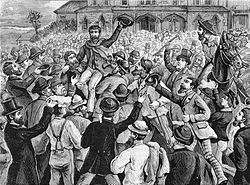
The discovery of gold in Victoria in mid-1851 sparked a gold rush, and Melbourne, the colony's major port, experienced rapid growth. Within months, the city's population had nearly doubled from 25,000 to 40,000 inhabitants.[53] Exponential growth ensued, and by 1865, Melbourne had overtaken Sydney as Australia's most populous city.[54]
An influx of intercolonial and international migrants, particularly from Europe and China, saw the establishment of slums, including Chinatown and a temporary "tent city" on the southern banks of the Yarra. In the aftermath of the 1854 Eureka Rebellion, mass public support for the plight of the miners resulted in major political changes to the colony, including improvements in working conditions across mining, agriculture, manufacturing and other local industries. At least twenty nationalities took part in the rebellion, giving some indication of immigration flows at the time.[55]
With the wealth brought in from the gold rush and the subsequent need for public buildings, a program of grand civic construction soon began. The 1850s and 1860s saw the commencement of Parliament House, the Treasury Building, the Old Melbourne Gaol, Victoria Barracks, the State Library, University of Melbourne, General Post Office, Customs House, the Melbourne Town Hall, St Patrick's cathedral, though many remained incomplete for decades.[citation needed]
The layout of the inner suburbs on a largely one-mile grid pattern, cut through by wide radial boulevards and parklands surrounding the central city, was largely established in the 1850s and 1860s. These areas rapidly filled with the ubiquitous terrace houses, as well as with detached houses and grand mansions, while some of the major roads developed as shopping streets. Melbourne quickly became a major finance centre, home to several banks, the Royal Mint, and (in 1861) Australia's first stock exchange.[56] In 1855, the Melbourne Cricket Club secured possession of its now famous ground, the MCG. Members of the Melbourne Football Club codified Australian football in 1859,[57] and in 1861, the first Melbourne Cup race was held. Melbourne acquired its first public monument, the Burke and Wills statue, in 1864.[58]
With the gold rush largely over by 1860, Melbourne continued to grow on the back of continuing gold-mining, as the major port for exporting the agricultural products of Victoria (especially wool) and with a developing manufacturing sector protected by high tariffs. An extensive radial railway network spread into the countryside from the late 1850s. Construction started on further major public buildings in the 1860s and 1870s, such as the Supreme Court, Government House, and the Queen Victoria Market. The central city filled up with shops and offices, workshops, and warehouses. Large banks and hotels faced the main streets, with fine townhouses in the east end of Collins Street, contrasting with tiny cottages down laneways within the blocks. The Aboriginal population continued to decline, with an estimated 80% total decrease by 1863,[citation needed] due primarily to introduced diseases (particularly smallpox[26]), frontier violence and dispossession of their lands.[59]

The 1880s saw extraordinary growth: consumer confidence, easy access to credit, and steep increases in land prices led to an enormous amount of construction. During this "land boom", Melbourne reputedly became the richest city in the world,[13] and the second-largest (after London) in the British Empire.[60]
The decade began with the Melbourne International Exhibition in 1880, held in the large purpose-built Exhibition Building. A telephone exchange was established that year, and the foundations of St Paul's were laid. In 1881, electric light was installed in the Eastern Market, and a generating station capable of supplying 2,000 incandescent lamps was in operation by 1882.[61] The Melbourne cable tramway system opened in 1885 and became one of the world's most extensive systems by 1890.[62]
In 1885, visiting English journalist George Augustus Henry Sala coined the phrase "Marvellous Melbourne", which stuck long into the twentieth century and has come to refer to the opulence and energy of the 1880s,[63] during which time large commercial buildings, grand hotels, banks, coffee palaces, terrace housing and palatial mansions proliferated in the city.[64] The establishment of the Melbourne Hydraulic Power Company in 1886 led to the availability of high-pressure piped water, allowing for the installation of hydraulically powered elevators, which led to the construction of the first high-rise buildings in the city.[65][66] The period also saw the huge expansion of a significant radial rail-based transport network throughout the city and suburbs.[67]
Melbourne's land-boom peaked in 1888,[64] the year it hosted the Centennial Exhibition. The brash boosterism that had typified Melbourne during that time ended in the early 1890s. The bubble supporting the local finance and property industries burst, resulting in a severe economic depression.[64][68] Sixteen small land banks and building societies collapsed, and 133 limited companies went into liquidation. The Melbourne financial crisis was a contributing factor to the Australian economic depression of the 1890s and the Australian banking crisis of 1893. The effects of the depression on the city were profound, with virtually no significant construction until the late 1890s.[69][70]
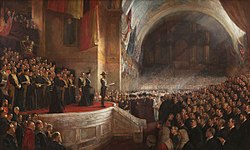
At the time of Australia's federation on 1 January 1901, Melbourne became the seat of government of the federated Commonwealth of Australia. The first federal parliament convened on 9 May 1901 in the Royal Exhibition Building, subsequently moving to the Victorian Parliament House, where it sat until it moved to Canberra in 1927. The Governor-General of Australia resided at Government House in Melbourne until 1930, and many major national institutions remained in Melbourne well into the twentieth century.[71] During World War II, the city hosted American military forces who were fighting the Empire of Japan, and the government requisitioned the Melbourne Cricket Ground for military use.[72]
In the immediate years after World War II, Melbourne expanded rapidly, its growth boosted by post-war immigration to Australia, primarily from Southern Europe and the Mediterranean.[73] While the "Paris End" of Collins Street began Melbourne's boutique shopping and open air cafe cultures,[74] the city centre was seen by many as stale—the dreary domain of office workers—something expressed by John Brack in his famous painting Collins St., 5 pm (1955).[75] Up until the 21st century, Melbourne was considered Australia's "industrial heartland".[76]
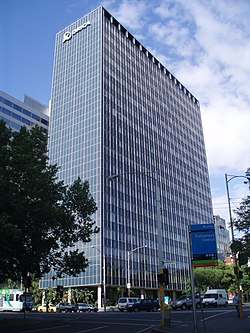
Height limits in the CBD were lifted in 1958, after the construction of ICI House, transforming the city's skyline with the introduction of skyscrapers. Suburban expansion then intensified, served by new indoor malls beginning with Chadstone Shopping Centre.[77] The post-war period also saw a major renewal of the CBD and St Kilda Road which significantly modernised the city.[78] New fire regulations and redevelopment saw most of the taller pre-war CBD buildings either demolished or partially retained through a policy of facadism. Many of the larger suburban mansions from the boom era were also either demolished or subdivided.
To counter the trend towards low-density suburban residential growth, the government began a series of controversial public housing projects in the inner city by the Housing Commission of Victoria, which resulted in the demolition of many neighbourhoods and a proliferation of high-rise towers.[79] In later years, with the rapid rise of motor vehicle ownership, the investment in freeway and highway developments greatly accelerated the outward suburban sprawl and declining inner-city population. The Bolte government sought to rapidly accelerate the modernisation of Melbourne. Major road projects including the remodelling of St Kilda Junction, the widening of Hoddle Street and then the extensive 1969 Melbourne Transportation Plan changed the face of the city into a car-dominated environment.[80]
Australia's financial and mining booms during 1969 and 1970 resulted in establishment of the headquarters of many major companies (BHP and Rio Tinto, among others) in the city. Nauru's then booming economy resulted in several ambitious investments in Melbourne, such as Nauru House.[81] Melbourne remained Australia's main business and financial centre until the late 1970s, when it began to lose this primacy to Sydney.[82]
Melbourne experienced an economic downturn between 1989 and 1992, following the collapse of several local financial institutions. In 1992, the newly elected Kennett government began a campaign to revive the economy with an aggressive development campaign of public works coupled with the promotion of the city as a tourist destination with a focus on major events and sports tourism.[83] During this period the Australian Grand Prix moved to Melbourne from Adelaide. Major projects included the construction of a new facility for the Melbourne Museum, Federation Square, the Melbourne Convention & Exhibition Centre, Crown Casino and the CityLink tollway. Other strategies included the privatisation of some of Melbourne's services, including power and public transport, and a reduction in funding to public services such as health, education and public transport infrastructure.[84]

Since the mid-1990s, Melbourne has maintained significant population and employment growth. There has been substantial international investment in the city's industries and property market. Major inner-city urban renewal has occurred in areas such as Southbank, Port Melbourne, Melbourne Docklands and South Wharf. Melbourne sustained the highest population increase and economic growth rate of any Australian capital city from 2001 to 2004.[85]
From 2006, the growth of the city extended into "green wedges" and beyond the city's urban growth boundary. Predictions of the city's population reaching 5 million people pushed the state government to review the growth boundary in 2008 as part of its Melbourne @ Five Million strategy.[86] In 2009, Melbourne was less affected by the Great Recession in comparison to other Australian cities. At this time, more new jobs were created in Melbourne than any other Australian city—almost as many as the next two fastest growing cities, Brisbane and Perth, combined,[87] and Melbourne's property market remained highly priced,[88] resulting in historically high property prices and widespread rent increases.[89]
Beginning in the 2010s, the State Government of Victoria initiated a number of major infrastructure projects designed to reduce congestion in Melbourne and encourage economic growth, including the Metro Tunnel, the West Gate Tunnel, the Level Crossing Removal Project and the Suburban Rail Loop.[90][91] New urban renewal zones were initiated in inner-city areas like Fisherman's Bend and Arden, while suburban growth continued on the urban periphery in Melbourne's outer west and east in suburbs like Wyndham Vale and Cranbourne.[92] Middle suburbs like Box Hill became denser as a greater proportion of Melburnians began living in apartments.[93] A construction boom resulted in 34 new skyscrapers being built in the central business district between 2010 and 2020.[94] In 2020, Melbourne was classified as an Alpha city by the Globalization and World Cities Research Network.[95]
Out of all major Australian cities, Melbourne was the worst affected by the COVID-19 pandemic and spent a long time under lockdown restrictions,[96] with Melbourne experiencing six lockdowns totalling 262 days.[97] While this contributed to a net outflow of migration causing a slight reduction in Melbourne's population over the course of 2020 to 2022, Melbourne's population is projected to reach 6.4 million people by 2033–34.[98][99]

Melbourne is in the southeastern part of mainland Australia, within the state of Victoria.[100] Geologically, it is built on the confluence of Quaternary lava flows to the west, Silurian mudstones to the east, and Holocene sand accumulation to the southeast along Port Phillip. The southeastern suburbs are situated on the Selwyn fault, which transects Mount Martha and Cranbourne.[101] The western portion of the metropolitan area lies within the Victorian Volcanic Plain grasslands vegetation community,[102][103] and the southeast falls in the Gippsland Plains Grassy Woodland zone.[104]
Melbourne extends northward through the undulating bushland valleys of the Yarra Valley's tributaries—Moonee Ponds Creek (toward Melbourne Airport),[105] Merri Creek, Darebin Creek and Plenty River.[106] The city reaches southeast through Dandenong to the growth corridor of Pakenham towards West Gippsland.[107] In the west, it extends along the Maribyrnong River and its tributaries north towards Sunbury.[108]
Melbourne's major bayside beaches are in the various suburbs along the shores of Port Phillip Bay, in areas like Port Melbourne, Albert Park, St Kilda, Elwood, Brighton, Sandringham, Mentone, Frankston, Altona, Williamstown and Werribee South. The nearest surf beaches are 85 kilometres (53 mi) south of the Melbourne CBD in the back-beaches of Rye, Sorrento and Portsea.[109][110]

Melbourne has a temperate oceanic climate (Köppen climate classification Cfb), with warm summers and cool winters.[111][112] Melbourne is well known for its changeable weather conditions, mainly due to it being located on the boundary of hot inland areas and the cool southern ocean. This temperature differential is most pronounced in the spring and summer months and can cause strong cold fronts to form. These cold fronts can be responsible for varied forms of severe weather from gales to thunderstorms and hail, large temperature drops and heavy rain. Winters, while exceptionally dry by southern Victorian standards, are nonetheless drizzly and overcast. The lack of winter rainfall is because of Melbourne's rain shadowed location between the Otway and Macedon Ranges, which block much of the rainfall arriving from the north and west.[113]
Port Phillip is often warmer than the surrounding oceans or the land mass, particularly in spring and autumn; this can set up a "bay effect rain", where showers are intensified leeward of the bay. Relatively narrow streams of heavy showers can often affect the same places (usually the eastern suburbs) for an extended period, while the rest of Melbourne and surrounds stays dry. Overall, the area around Melbourne is, owing to its rain shadow, nonetheless significantly drier than average for southern Victoria.[114] Within the city and surrounds, rainfall varies widely, from around 425 millimetres (16.7 in) at Little River to 1,250 millimetres (49 in) on the eastern fringe at Gembrook. Melbourne receives 48.6 clear days annually. Dewpoint temperatures in the summer range from 9.5 to 11.7 °C (49.1 to 53.1 °F).[115]
Melbourne is also prone to isolated convective showers forming when a cold pool crosses the state, especially if there is considerable daytime heating. These showers are often heavy and can include hail, squalls, and significant drops in temperature, but they often pass through very quickly with a rapid clearing trend to sunny and relatively calm weather and the temperature rising back to what it was before the shower. This can occur in the space of minutes and can be repeated many times a day, giving Melbourne a reputation for having "four seasons in one day",[115] a phrase that is part of local popular culture.[116] The lowest temperature on record is −2.8 °C (27.0 °F), on 21 July 1869.[117] The highest temperature recorded in Melbourne city was 46.4 °C (115.5 °F), on 7 February 2009.[117] While snow is occasionally seen at higher elevations in the outskirts of the city, and dustings were observed in 2020, it has not been recorded in the central business district since 1986.[118]
The sea temperature in Melbourne is warmer than the surrounding ocean during the summer months, and colder during the winter months. This is predominantly due to Port Phillip Bay being an enclosed and shallow bay that is largely protected from the ocean,[119] resulting in greater temperature variation across seasons.
| Climate data for Melbourne Airport (1991–2020 averages, 1970–2024 extremes) | |||||||||||||
|---|---|---|---|---|---|---|---|---|---|---|---|---|---|
| Month | Jan | Feb | Mar | Apr | May | Jun | Jul | Aug | Sep | Oct | Nov | Dec | Year |
| Record high °C (°F) | 46.0 (114.8) |
46.8 (116.2) |
40.8 (105.4) |
34.5 (94.1) |
27.0 (80.6) |
21.8 (71.2) |
22.7 (72.9) |
25.6 (78.1) |
30.2 (86.4) |
36.0 (96.8) |
41.6 (106.9) |
44.6 (112.3) |
46.8 (116.2) |
| Mean maximum °C (°F) | 40.4 (104.7) |
38.2 (100.8) |
34.7 (94.5) |
28.8 (83.8) |
22.7 (72.9) |
18.0 (64.4) |
17.3 (63.1) |
19.8 (67.6) |
24.6 (76.3) |
30.2 (86.4) |
34.3 (93.7) |
37.6 (99.7) |
41.3 (106.3) |
| Mean daily maximum °C (°F) | 27.0 (80.6) |
26.7 (80.1) |
24.4 (75.9) |
20.6 (69.1) |
16.7 (62.1) |
14.0 (57.2) |
13.4 (56.1) |
14.7 (58.5) |
17.1 (62.8) |
20.0 (68.0) |
22.6 (72.7) |
24.8 (76.6) |
20.2 (68.3) |
| Daily mean °C (°F) | 20.6 (69.1) |
20.6 (69.1) |
18.6 (65.5) |
15.4 (59.7) |
12.5 (54.5) |
10.2 (50.4) |
9.6 (49.3) |
10.4 (50.7) |
12.1 (53.8) |
14.3 (57.7) |
16.6 (61.9) |
18.5 (65.3) |
14.9 (58.8) |
| Mean daily minimum °C (°F) | 14.2 (57.6) |
14.4 (57.9) |
12.8 (55.0) |
10.1 (50.2) |
8.3 (46.9) |
6.4 (43.5) |
5.8 (42.4) |
6.0 (42.8) |
7.2 (45.0) |
8.7 (47.7) |
10.6 (51.1) |
12.3 (54.1) |
9.7 (49.5) |
| Mean minimum °C (°F) | 8.5 (47.3) |
8.7 (47.7) |
7.1 (44.8) |
4.4 (39.9) |
3.0 (37.4) |
1.3 (34.3) |
0.9 (33.6) |
1.1 (34.0) |
1.8 (35.2) |
3.1 (37.6) |
4.9 (40.8) |
6.6 (43.9) |
0.2 (32.4) |
| Record low °C (°F) | 6.0 (42.8) |
4.8 (40.6) |
3.7 (38.7) |
1.2 (34.2) |
0.6 (33.1) |
−0.9 (30.4) |
−2.5 (27.5) |
−2.5 (27.5) |
−1.1 (30.0) |
1.0 (33.8) |
0.9 (33.6) |
3.5 (38.3) |
−2.5 (27.5) |
| Average precipitation mm (inches) | 39.3 (1.55) |
41.4 (1.63) |
37.5 (1.48) |
42.1 (1.66) |
34.3 (1.35) |
41.5 (1.63) |
32.8 (1.29) |
39.3 (1.55) |
46.1 (1.81) |
48.5 (1.91) |
60.1 (2.37) |
52.5 (2.07) |
515.5 (20.30) |
| Average precipitation days (≥ 0.2 mm) | 8.3 | 7.5 | 8.4 | 9.9 | 12.0 | 13.0 | 14.0 | 14.8 | 13.9 | 12.5 | 10.8 | 9.9 | 135.0 |
| Average afternoon relative humidity (%) | 44 | 45 | 46 | 50 | 59 | 65 | 63 | 57 | 53 | 49 | 47 | 45 | 52 |
| Mean monthly sunshine hours | 272.8 | 231.7 | 226.3 | 183.0 | 142.6 | 120.0 | 136.4 | 167.4 | 186.0 | 226.3 | 225.0 | 263.5 | 2,381 |
| Percentage possible sunshine | 61 | 61 | 59 | 56 | 46 | 43 | 45 | 51 | 52 | 56 | 53 | 58 | 53 |
| Source: [120][121][122] | |||||||||||||
| Climate data for Melbourne CBD (1991–2015 averages, extremes 1910–2015) | |||||||||||||
|---|---|---|---|---|---|---|---|---|---|---|---|---|---|
| Month | Jan | Feb | Mar | Apr | May | Jun | Jul | Aug | Sep | Oct | Nov | Dec | Year |
| Record high °C (°F) | 45.6 (114.1) |
46.4 (115.5) |
41.7 (107.1) |
34.9 (94.8) |
28.1 (82.6) |
22.4 (72.3) |
23.3 (73.9) |
26.5 (79.7) |
31.4 (88.5) |
36.9 (98.4) |
40.7 (105.3) |
42.9 (109.2) |
46.4 (115.5) |
| Mean maximum °C (°F) | 40.3 (104.5) |
38.4 (101.1) |
34.7 (94.5) |
29.2 (84.6) |
23.4 (74.1) |
18.9 (66.0) |
18.5 (65.3) |
21.0 (69.8) |
25.5 (77.9) |
30.8 (87.4) |
34.6 (94.3) |
37.4 (99.3) |
41.2 (106.2) |
| Mean daily maximum °C (°F) | 27.0 (80.6) |
26.9 (80.4) |
24.6 (76.3) |
21.1 (70.0) |
17.6 (63.7) |
15.1 (59.2) |
14.5 (58.1) |
15.9 (60.6) |
18.1 (64.6) |
20.5 (68.9) |
22.9 (73.2) |
24.8 (76.6) |
20.8 (69.4) |
| Daily mean °C (°F) | 21.5 (70.7) |
21.6 (70.9) |
19.6 (67.3) |
16.5 (61.7) |
13.7 (56.7) |
11.7 (53.1) |
11.0 (51.8) |
11.9 (53.4) |
13.8 (56.8) |
15.7 (60.3) |
17.9 (64.2) |
19.6 (67.3) |
16.2 (61.2) |
| Mean daily minimum °C (°F) | 16.1 (61.0) |
16.4 (61.5) |
14.6 (58.3) |
11.8 (53.2) |
9.8 (49.6) |
8.2 (46.8) |
7.5 (45.5) |
7.9 (46.2) |
9.4 (48.9) |
10.9 (51.6) |
12.8 (55.0) |
14.3 (57.7) |
11.6 (52.9) |
| Mean minimum °C (°F) | 11.4 (52.5) |
11.8 (53.2) |
9.7 (49.5) |
6.4 (43.5) |
4.4 (39.9) |
3.1 (37.6) |
2.9 (37.2) |
3.0 (37.4) |
4.4 (39.9) |
5.8 (42.4) |
7.9 (46.2) |
9.5 (49.1) |
2.1 (35.8) |
| Record low °C (°F) | 6.7 (44.1) |
4.5 (40.1) |
4.1 (39.4) |
1.9 (35.4) |
−1.1 (30.0) |
−1.1 (30.0) |
−1.5 (29.3) |
−1.5 (29.3) |
−0.5 (31.1) |
0.1 (32.2) |
2.7 (36.9) |
5.9 (42.6) |
−1.5 (29.3) |
| Average rainfall mm (inches) | 44.2 (1.74) |
50.2 (1.98) |
39.0 (1.54) |
53.2 (2.09) |
43.9 (1.73) |
49.5 (1.95) |
39.8 (1.57) |
47.0 (1.85) |
54.5 (2.15) |
55.8 (2.20) |
63.3 (2.49) |
60.9 (2.40) |
601.3 (23.69) |
| Source: Bureau of Meteorology[123] | |||||||||||||
| Jan | Feb | Mar | Apr | May | Jun | Jul | Aug | Sep | Oct | Nov | Dec |
|---|---|---|---|---|---|---|---|---|---|---|---|
| 21.1 °C (70.0 °F) |
21.4 °C (70.5 °F) |
20.2 °C (68.4 °F) |
17.9 °C (64.2 °F) |
15.1 °C (59.2 °F) |
12.7 °C (54.9 °F) |
11.1 °C (52.0 °F) |
10.9 °C (51.6 °F) |
12.3 °C (54.1 °F) |
14.5 °C (58.1 °F) |
17.1 °C (62.8 °F) |
19.2 °C (66.6 °F) |


Melbourne's urban area is approximately 2,704 kilometres2, the largest in Australia and the 33rd largest in the world.[125] The Hoddle Grid, a grid of streets measuring approximately 1 by 1⁄2 mi (1.61 by 0.80 km), forms the nucleus of Melbourne's central business district (CBD). The grid's southern edge fronts onto the Yarra River. More recent office, commercial and public developments in the adjoining districts of Southbank and Docklands have made these areas into extensions of the CBD in all but name. A byproduct of the CBD's layout is its network of lanes and arcades, such as Block Arcade and Royal Arcade.[126][127]
Melbourne's CBD has become Australia's most densely populated area, with approximately 19,500 residents per square kilometre,[128] and is home to more skyscrapers than any other Australian city, the tallest being Australia 108, situated in Southbank.[129] Melbourne's newest planned skyscraper, Southbank By Beulah[130] (also known as "Green Spine"), has recently been approved for construction and will likely be the tallest building in Australia when completed.
The CBD and surrounds also contain many significant historic buildings such as the Royal Exhibition Building, the Melbourne Town Hall and Parliament House.[131][132]
Although the area is described as the centre, it is not actually the demographic centre of Melbourne at all, due to an urban sprawl to the southeast, the demographic centre being located at Camberwell.[133]
Melbourne is typical of Australian capital cities in that after the turn of the 20th century, it expanded with the underlying notion of a 'quarter acre home and garden' for every family, often referred to locally as the Australian Dream.[134][135] This, coupled with the popularity of the private automobile after 1945, led to the auto-centric urban structure now present today in the middle and outer suburbs. Much of metropolitan Melbourne is accordingly characterised by low-density sprawl, whilst its inner-city areas feature predominantly medium-density, transit-oriented urban forms. The city centre, Docklands, St. Kilda Road and Southbank areas feature high-density forms.
Melbourne is often referred to as Australia's garden city, and the state of Victoria is known as the garden state.[136][137] There is an abundance of parks and gardens in Melbourne,[138] many close to the CBD with a variety of common and rare plant species amid landscaped vistas, pedestrian pathways and tree-lined avenues. Melbourne's parks are often considered the best public parks in all of Australia's major cities.[139] There are also many parks in the surrounding suburbs of Melbourne, such as in the municipalities of Stonnington, Boroondara and Port Phillip, southeast of the central business district. Several national parks have been designated around the urban area of Melbourne, including the Mornington Peninsula National Park, Port Phillip Heads Marine National Park and Point Nepean National Park in the southeast, Organ Pipes National Park to the north and Dandenong Ranges National Park to the east. There are also a number of significant state parks just outside Melbourne.[140][141] The extensive area covered by urban Melbourne is formally divided into hundreds of suburbs (for addressing and postal purposes), and administered as local government areas,[142] 31 of which are located within the metropolitan area.[143]

Melbourne has minimal public housing and high demand for rental housing, which is becoming unaffordable for many.[144][145][146] Public housing is managed and provided by the Victorian Government's Department of Families, Fairness and Housing, and operates within the framework of the Commonwealth-State Housing Agreement, by which both federal and state governments provide funding for housing.
Melbourne is experiencing high population growth, generating high demand for housing. This housing boom has increased house prices and rents, as well as the availability of all types of housing. Subdivision regularly occurs in the outer areas of Melbourne, with numerous developers offering house and land packages. However, since the release of Melbourne 2030 in 2002, planning policies have encouraged medium-density and high-density development in existing areas with good access to public transport and other services. As a result of this, Melbourne's middle and outer-ring suburbs have seen significant brownfields redevelopment.[147]

On the back of the 1850s gold rush and 1880s land boom, Melbourne became renowned as one of the world's great Victorian-era cities, a reputation that persists due to its diverse range of Victorian architecture.[148] High concentrations of well-preserved Victorian-era buildings can be found in the inner suburbs, such as Carlton, East Melbourne and South Melbourne.[149] Outstanding examples of Melbourne's built Victorian heritage include the World Heritage-listed Royal Exhibition Building (1880), the General Post Office (1867), Hotel Windsor (1884) and the Block Arcade (1891).[150] Comparatively little remains of Melbourne's pre-gold rush architecture; St James Old Cathedral (1839) and St Francis' Church (1845) are among the few examples left in the CBD. Many of the CBD's Victorian boom-time landmarks were also demolished in the decades after World War II, including the Federal Coffee Palace (1888) and the APA Building (1889), one of the tallest early skyscrapers upon completion.[151][152] Heritage listings and heritage overlays have since been introduced in an effort to prevent further losses of the city's historic fabric.

In line with the city's expansion during the early 20th century, suburbs such as Hawthorn and Camberwell are defined largely by Federation and Edwardian architectural styles. The City Baths, built in 1903, are a prominent example of the latter style in the CBD. The 1926 Nicholas Building is the city's grandest example of the Chicago School style, while the influence of Art Deco is apparent in the Manchester Unity Building, completed in 1932. The city also features the Shrine of Remembrance, which was built as a memorial to the men and women of Victoria who served in World War I and is now a memorial to all Australians who have served in war.
Residential architecture is not defined by a single architectural style, but rather an eclectic mix of large McMansion-style houses (particularly in areas of urban sprawl), apartment buildings, condominiums, and townhouses which generally characterise the medium-density inner-city neighbourhoods. Freestanding dwellings with relatively large gardens are perhaps the most common type of housing outside inner city Melbourne. Victorian terrace housing, townhouses and historic Italianate, Tudor Revival and Neo-Georgian mansions are all common in inner-city neighbourhoods such as Carlton, Fitzroy and further into suburban enclaves like Toorak.[153]

Often referred to as Australia's cultural capital, Melbourne is known for its music, theatre and arts scenes, as well as its diverse range of cultural events and festivals, including the Melbourne International Arts Festival, Melbourne Fringe Festival and Moomba, Australia's largest free community festival.[154] For much of the 2010s, Melbourne topped The Economist Intelligence Unit's list of the world's most liveable cities, partly due to its cultural attributes.[17]
State Library Victoria, founded in 1854, is one of the world's oldest free public libraries and, as of 2018, the fourth most-visited library globally.[155] During the 19th-century boom period, Melbourne-based authors and poets Marcus Clarke, Adam Lindsay Gordon and Rolf Boldrewood produced classic visions of colonial life,[156] and many visiting writers recorded literary responses to the city: for Henry Kendall, it was a "wild bleak Bohemia",[157] while Henry Kingsley stated that, in its rapid growth, Melbourne "surpasses all human experience".[158] Fergus Hume's The Mystery of a Hansom Cab (1886), the fastest-selling crime novel of the era, is set in Melbourne, as is Australia's best-selling book of poetry, The Songs of a Sentimental Bloke (1915) by C. J. Dennis.[159] Contemporary Melbourne authors who have set novels in the city include Peter Carey, Helen Garner and Gerald Murnane.[160] Melbourne has Australia's widest range of bookstores, as well as the nation's largest publishing sector.[161] The city also hosts the Melbourne Writers Festival and the Victorian Premier's Literary Awards. In 2008, it became the second UNESCO City of Literature.[162]

Melbourne is home to many theatres, eight of which are concentrated in the East End Theatre District, including the Victorian era Athenaeum, Her Majesty's and Princess theatres, as well as the Forum and the Regent. Other heritage-listed theatres include the avant-garde picture palace The Capitol and St Kilda's Palais Theatre, Australia's largest seated theatre with a capacity of 3,000 people.[163] The Arts Precinct in Southbank is home to Arts Centre Melbourne (which includes the State Theatre and Hamer Hall), as well as the Melbourne Recital Centre, Malthouse Theatre and Southbank Theatre, home of the Melbourne Theatre Company, Australia's oldest professional theatre company.[164] The Australian Ballet, Opera Australia and Melbourne Symphony Orchestra are also based in the precinct. Many of Melbourne's theatres join the Melbourne Town Hall in hosting the annual Melbourne International Comedy Festival, one of the world's three largest comedy festivals.[165]

Melbourne has been called "the live music capital of the world";[166] one study found it has more music venues per capita than any other world city sampled, with 17.5 million patron visits to 553 venues in 2016.[166][167] Australia's first global music star, opera singer Nellie Melba, took her stage name from her hometown. Composer Percy Grainger followed her in becoming the most famous Melburnian of the Edwardian era. The Sidney Myer Music Bowl in Kings Domain hosted the largest crowd ever for a music concert in Australia when an estimated 200,000 attendees saw Melbourne band The Seekers in 1967.[168] Airing between 1974 and 1987, Melbourne's Countdown helped launch the careers of local acts as diverse as AC/DC[169] and Kylie Minogue. Several distinct post-punk scenes flourished in Melbourne during the late 1970s and early 1980s, including the Little Band scene and St Kilda's Crystal Ballroom scene, which gave rise to Dead Can Dance and Nick Cave and the Bad Seeds.[170] More recent independent acts from Melbourne to achieve global recognition include The Avalanches, Gotye and King Gizzard and the Lizard Wizard. Melbourne is also regarded as a centre of EDM, and lends its name to the Melbourne Bounce genre and the Melbourne Shuffle dance style, both of which emerged from the city's underground rave scene.[171]

Established in 1861, the National Gallery of Victoria is Australia's oldest and largest art museum, and houses its collection across two sites: NGV International in Southbank and NGV Australia at Federation Square. Several art movements originated in Melbourne, most famously the Heidelberg School of impressionists, named after a suburb where they camped to paint en plein air in the 1880s.[172] The Australian tonalists followed in the 1910s,[173] some of whom founded Montsalvat in Eltham, Australia's oldest surviving art colony. Mid-century Melbourne became a stronghold of figurative modernism through the paintings of the Antipodeans and Angry Penguins; the latter group often met at a pastoral estate in Bulleen, now the Heide Museum of Modern Art.[174] The city is also home to the Australian Centre for Contemporary Art, as well as numerous independent galleries and artist-run spaces. In the 2000s, street art proliferated in Melbourne, with Banksy saying its graffiti scene "leads the world",[175] and "laneway galleries" becoming major tourist sites; Hosier Lane for example attracts more Instagram hashtags than some of the city's traditional destinations, like the Melbourne Zoo.[176][177] Melbourne's many public artworks range from the Burke and Wills monument (1865) to the abstract sculpture Vault (1978), the latter a popular reference point amongst Melbourne designers.[178]

The oldest film in Australia's National Film and Sound Archive is of the 1896 Melbourne Cup.[179] Melbourne filmmakers spurred Australia's first cinematic boom with The Story of the Kelly Gang (1906), shot a quarter century after bushranger Ned Kelly's execution at Old Melbourne Gaol, and since recognised as the world's first feature-length narrative film.[180] Melbourne remained a world leader in film production until the mid-1910s, when several factors, including a ban on bushranger films, contributed to a decades-long decline of the industry.[180] A notable film shot and set in Melbourne during this lull was On the Beach (1959).[181] In the wake of the 1970s Australian Film Revival, many films have been shot and set in Melbourne, including Mad Max (1979),[182] Romper Stomper (1992),[179] Chopper (2000) and Animal Kingdom (2010).[182] The Melbourne International Film Festival began in 1952 and is one of the world's oldest film festivals.[183] The AACTA Awards, Australia's top screen awards, were inaugurated by the festival in 1958. Docklands Studios Melbourne is the city's largest film and television studio complex and has attracted major international productions.[184] Melbourne is also home to the ACMI, the Australian Centre for the Moving Image.[185]


Melbourne has long been regarded as Australia's sporting capital due to the role it has played in the development of Australian sport, the range and quality of its sporting events and venues, and its high rates of spectatorship and participation.[186] It is also sometimes dubbed the sporting capital of the world.[187] The city is also home to 27 professional sports teams competing at the national level, the most of any Australian city. Melbourne's sporting reputation was recognised in 2016 when, after being ranked as the world's top sports city three times biennially, the Ultimate Sports City Awards in Switzerland named it 'Sports City of the Decade'.[188]
The city has hosted a number of major international sporting events, most notably the 1956 Summer Olympics, the first Olympic Games held outside Europe and the United States.[189] Melbourne also hosted the 2006 Commonwealth Games, and is home to several major annual international events, including the Australian Open, the first of the four Grand Slam tennis tournaments. First held in 1861 and declared a public holiday for all Melburnians in 1873, the Melbourne Cup is the world's richest handicap horse race, and is known as "the race that stops a nation".[190] The Formula One Australian Grand Prix has been held at the Albert Park Circuit since 1996.[191]
Cricket was one of the first sports to become organised in Melbourne with the Melbourne Cricket Club forming within three years of settlement. The club manages one of the world's largest stadiums, the 100,000 capacity Melbourne Cricket Ground (MCG).[192][193] Established in 1853, the MCG is notable for hosting the first Test match and the first One Day International, played between Australia and England in 1877 and 1971, respectively. It is also the home of the National Sports Museum,[194] and serves as the home ground of the Victoria cricket team. At Twenty20 level, the Melbourne Stars and Melbourne Renegades compete in the Big Bash League.
Australian rules football, Australia's most popular spectator sport, traces its origins to matches played in parklands next to the MCG in 1858. Its first laws were codified the following year by the Melbourne Football Club,[195] also a founding member, in 1896, of the Australian Football League (AFL), the sport's elite professional competition. Headquartered at Docklands Stadium, the AFL fields a further eight Melbourne-based clubs: Carlton, Collingwood, Essendon, Hawthorn, North Melbourne, Richmond, St Kilda, and the Western Bulldogs.[196] The city hosts up to five AFL matches per round during the home and away season, attracting an average of 40,000 spectators per game.[197] The AFL Grand Final, traditionally held at the MCG, is the highest attended club championship event in the world.
In soccer, Melbourne is represented in the A-League by Melbourne Victory, Melbourne City FC and Western United FC, and in rugby league it is home to the National Rugby League team, Melbourne Storm. North American sports have also gained popularity in Melbourne: basketball sides South East Melbourne Phoenix and Melbourne United play in the NBL; Melbourne Ice and Melbourne Mustangs play in the Australian Ice Hockey League; and Melbourne Aces plays in the Australian Baseball League. Rowing also forms part of Melbourne's sporting identity, with a number of clubs located on the Yarra River, out of which many Australian Olympians trained.

Melbourne has a highly diversified economy with particular strengths in finance, manufacturing, research, IT, education, logistics, transportation and tourism. Melbourne houses the headquarters of many of Australia's largest corporations, including five of the ten largest in the country (based on revenue), and five of the largest seven in the country (based on market capitalisation);[198] ANZ, BHP, the National Australia Bank, CSL and Telstra, as well as such representative bodies and think tanks as the Business Council of Australia and the Australian Council of Trade Unions. Melbourne's suburbs also have the head offices of Coles Group (owner of Coles Supermarkets) and Wesfarmers companies Bunnings, Target, K-Mart and Officeworks, as well as the head office for Australia Post. The city is home to Australia's second busiest seaport, after Port Botany in Sydney.[199] Melbourne Airport provides an entry point for national and international visitors, and is Australia's second busiest airport.[200]
Melbourne is also an important financial centre. In the 2024 Global Financial Centres Index, Melbourne was ranked as having the 28th most competitive financial centre in the world.[16] Two of the big four banks, the ANZ and National Australia Bank, are headquartered in Melbourne. The city has carved out a niche as Australia's leading centre for superannuation (pension) funds, with 40% of the total, and 65% of industry super-funds including the AU$109 billion-dollar Federal Government Future Fund. The city was rated 41st within the top 50 financial cities as surveyed by the MasterCard Worldwide Centers of Commerce Index (2008),[201] second only to Sydney (12th) in Australia. Melbourne is Australia's second-largest industrial centre.[202]

It is the Australian base for a number of significant manufacturers including Boeing Australia, truck-makers Kenworth and Iveco, Cadbury as well as Alstom and Jayco, among others. It is also home to a wide variety of other manufacturers, ranging from petrochemicals and pharmaceuticals to fashion garments, paper manufacturing and food processing.[204] The south-eastern suburb of Scoresby is home to Nintendo's Australian headquarters. The city also has a research and development hub for Ford Australia, as well as a global design studio and technical centre for General Motors and Toyota Australia respectively.
CSL, one of the world's top five biotech companies, and Sigma Pharmaceuticals have their headquarters in Melbourne. The two are the largest listed Australian pharmaceutical companies.[205] Melbourne has an important ICT industry, home to more than half of Australia's top 20 technology companies, and employs over 91,000 people (one third of Australia's ICT workforce), with a turnover of AU$34 billion and export revenues of AU$2.5 billion in 2018.[206] In addition, tourism also plays an important role in Melbourne's economy, with 10.8 million domestic overnight tourists and 2.9 million international overnight tourists in 2018.[207] Melbourne has been attracting an increasing share of domestic and international conference markets. Construction began in February 2006 of an AU$1 billion 5000-seat international convention centre, Hilton Hotel and commercial precinct adjacent to the Melbourne Convention & Exhibition Centre to link development along the Yarra River with the Southbank precinct and multibillion-dollar Docklands redevelopment.[208]

Melbourne is the second most visited city in Australia and the seventy-third most visited city in the world.[209] In 2018, 10.8 million domestic overnight tourists and 2.9 million international overnight tourists visited Melbourne.[207] The most visited attractions are Federation Square, Queen Victoria Market, Crown Casino, Southbank, Melbourne Zoo, Melbourne Aquarium, Docklands, National Gallery of Victoria, Melbourne Museum, Melbourne Observation Deck, Arts Centre Melbourne, and the Melbourne Cricket Ground.[210] The State Library of Victoria is the fourth most visited in the world.[155] Luna Park, a theme park modelled on New York's Coney Island and Seattle's Luna Park,[211] is also a popular destination for visitors.[212] In its annual survey of readers, the Condé Nast Traveler magazine found that both Melbourne and Auckland were considered the world's friendliest cities in 2014.[213][214] Melbourne's laneways and arcades are of particular importance for the city's tourism–Hosier Lane attracted one million visitors in each year prior to the COVID pandemic.[215] The laneways of Melbourne have been gentrified and now include prominent displays of street art, which attracts international tourists. Melbourne is considered one of the safest world cities for travellers.[216][217]

Melbourne has a renowned culinary scene that attracts international tourists.[218][219][220] Lygon Street, which runs through the inner-northern suburbs of Melbourne, is a popular dining destination with an abundance of Italian and Greek restaurants that date back to earlier European immigration of the city. Food festivals are of particular popularity in Melbourne, many of which are held during early autumn, earning this period the nickname "mad March".[221] The most well-known of these events, the Melbourne Food and Wine Festival, takes place over the course of ten days and began in 1993.[222][223]

Melbourne is also home to many annual events and festivals. The Melbourne International Comedy Festival is held every year in March through to April. Established in 1987, it is one of the three largest international comedy festivals in the world. Other notable festivals and events include the Melbourne Flower and Garden Show, the Melbourne International Jazz Festival, the Melbourne Royal Show and the Midsumma Festival.
| Country of birth (2021)[224] | |
|---|---|
| Birthplace[note 2] | Population |
| Australia | 2,947,136 |
| India | 242,635 |
| Mainland China | 166,023 |
| England | 132,912 |
| Vietnam | 90,552 |
| New Zealand | 82,939 |
| Sri Lanka | 65,152 |
| Philippines | 58,935 |
| Italy | 58,081 |
| Malaysia | 57,345 |
| Greece | 44,956 |
| Pakistan | 29,067 |
| South Africa | 27,056 |
| Iraq | 25,041 |
| Hong Kong SAR | 24,428 |
| Afghanistan | 23,525 |
| Iran | 20,922 |
| United States | 20,231 |
Melbourne is projected to overtake Sydney as Australia's most populous city sometime between 2032 and 2046.[225]
After a trend of declining population density since World War II, the city has seen increased density in the inner and western suburbs, aided in part by Victorian Government planning, such as Postcode 3000 and Melbourne 2030, which have aimed to curtail urban sprawl.[226][227] As of 2018[update], the CBD is the most densely populated area in Australia with more than 19,000 residents per square kilometre, and the inner city suburbs of Carlton, South Yarra, Fitzroy and Collingwood make up Victoria's top five.[228][229]
At the 2021 census, the most commonly nominated ancestries were:[224]
At the 2021 census, 0.7% of Melbourne's population identified as being Indigenous — Aboriginal Australians and Torres Strait Islanders.[note 3][230] In Greater Melbourne at the 2021 census, 59.9% of residents were born in Australia. The other most common countries of birth were India (4.9%), Mainland China (3.4%), England (2.7%), Vietnam (1.8%) and New Zealand (1.7%).[230]
At the time of the 2021 census, 61.1% of Melburnians speak only English at home. Mandarin (4.3%), Vietnamese (2.3%), Greek (2.1%), Punjabi (2%), and Arabic (1.8%) were the most common foreign languages spoken at home by residents of Melbourne.

Melbourne has a wide range of religious faiths, the most widely held of which is Christianity. This is signified by the city's two large cathedrals—St Patrick's (Roman Catholic), and St Paul's (Anglican). Both were built in the Victorian era and are of considerable heritage significance as major landmarks of the city.[232] In recent years, Greater Melbourne's irreligious community has grown to be one of the largest in Australia.[233]
According to the 2021 Census, persons stating that they had no religion constituted 36.9% of the population.[230] Christianity was the most popular religious affiliation at 40.1%.[230] The largest Christian denominations were Catholicism (20.8%) and Anglicanism (5.5%).[230] The most popular non-Christian religious affiliations were Islam (5.3%), Hinduism (4.1%), Buddhism (3.9%), Sikhism (1.7%) and Judaism (0.9%).[230]
Over 258,000 Muslims live in Melbourne.[234] Muslim religious life in Melbourne is centred on about 25 mosques and a number of prayer rooms at university campuses, workplaces and other venues.[235] As of 2000[update], Melbourne had the largest population of Polish Jews and Holocaust survivors in Australia, and the largest number of Jewish institutions.[236]
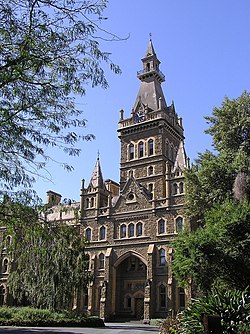
Of the top twenty high schools in Australia according to the My Choice Schools Ranking, five are in Melbourne.[237] There has also been a rapid increase in the number of International students studying in the city, with Melbourne considered the 5th best student city in the world for studying abroad in the 2026 Best Student Cities ranking by QS.[238] Eight public universities operate in Melbourne: the University of Melbourne, Monash University, Swinburne University of Technology, Deakin University, Royal Melbourne Institute of Technology (RMIT University), La Trobe University, Australian Catholic University (ACU) and Victoria University (VU).
Melbourne universities have campuses all over Australia and some internationally. Swinburne University and Monash University have campuses in Malaysia, RMIT in Vietnam, with Monash also having a campus in Indonesia and research centres in Prato, Italy, and a joint partnership research academy with IIT Bombay in Mumbai, India. The University of Melbourne, the second oldest university in Australia,[239] is the highest ranked university in Australia across the three major global rankings as of July 2025 – QS (19th),[240] THES (39th)[241] and the Academic Ranking of World Universities (37nd),[242] with Monash University also ranking within the top 50 – QS (36th).[240] Both are members of the Group of Eight, a coalition of leading Australian tertiary institutions offering comprehensive and leading education.[243]
As of 2025 RMIT University is ranked 21st in the world in Architecture.[244] The Swinburne University of Technology, based in the inner-city Melbourne suburb of Hawthorn, was as of 2014 ranked 76th–100th in the world for physics by the Academic Ranking of World Universities.[245] Deakin University maintains two major campuses in Melbourne and Geelong, and is the third largest university in Victoria. In recent years, the number of international students at Melbourne's universities has risen rapidly, a result of an increasing number of places being made available for them.[246] Education in Melbourne is overseen by the Victorian Department of Education (DET), whose role is to 'provide policy and planning advice for the delivery of education'.[247]

Three daily newspapers serve Melbourne: the Herald Sun (tabloid), The Age (compact) and The Australian (national broadsheet). There are six primary free-to-air digital television stations operating in Greater Melbourne and Geelong: ABC Victoria, (ABV), SBS Victoria (SBS), Seven Melbourne (HSV), Nine Melbourne (GTV), Ten Melbourne (ATV), C31 Melbourne (MGV) – community television.[248] Each station (excluding C31) broadcasts a primary channel and several multichannels.[249] Some digital media companies such as Broadsheet are based in and primarily serve Melbourne.
Many AM and FM radio stations broadcast to greater Melbourne. These include public (i.e., state-owned ABC and SBS) and community stations. Many commercial stations are networked-owned: Nova Entertainment owns Nova 100 and Smooth; ARN controls Gold 104.3 and KIIS 101.1; and Southern Cross Austereo runs both Fox and Triple M. Youth stations include ABC Triple J and youth-run SYN. Triple J, and community stations PBS and Triple R, strive to play under represented music. JOY 94.9 caters for gay, lesbian, bisexual and transgender audiences. 3MBS and ABC Classic FM play classical music. Light FM is a contemporary Christian station. AM stations include ABC: ABC Radio Melbourne, Radio National, and News Radio; also Nine Entertainment affiliates 3AW (talk) and Magic (easy listening). SEN 1116 broadcasts sports coverage. Melbourne has many community run stations that serve alternative interests, such as 3CR and 3KND (Indigenous). Many suburbs have low powered community run stations serving local audiences.[250]

The governance of Melbourne is split between the government of Victoria and the 27 cities and four shires that make up the metropolitan area. There is no ceremonial or political head of Melbourne, but the Lord Mayor of the City of Melbourne often fulfils such a role as a first among equals.[251]
The local governments are responsible for providing the functions set out in the Local Government Act 1989[252] such as urban planning and waste management. Most other government services are provided or regulated by the Victorian state government, which governs from Parliament House in Spring Street. These include services associated with local government in other countries and include public transport, main roads, traffic control, policing, education above preschool level, health and planning of major infrastructure projects.

Like many Australian cities, Melbourne has a high dependency on the automobile for transport,[253] particularly in the outer suburban areas where the largest number of cars are bought.[254] There a total of 3.6 million private vehicles using 22,320 km (13,870 mi) of road in Melbourne, which has one of the highest lengths of road per capita in the world.[253] The early 20th century saw an increase in popularity of automobiles, resulting in large-scale suburban expansion and a tendency towards the development of urban sprawl—like all Australian cities, inhabitants would live in the suburbs and commute to the city for work.[255] By the mid-1950s, there were just under 200 passenger vehicles per 1000 people, and by 2013, there were 600 passenger vehicles per 1000 people.[256]
The road network in Victoria is managed by the Department of Transport and Planning (DTP) who oversee planning and integration. Maintenance of roads is undertaken by different bodies, depending on the road. Local roads are maintained by local governments, while secondary and main roads are the responsibility of DTP. Major national freeways and roads integral to national trade are overseen by the Federal Government.[257]
Today, Melbourne has an extensive network of freeways and arterial roadways. These are used by private vehicles, including road freight vehicles, as well as road-based public transport modes like buses and taxis. Major highways feeding into the city include the Eastern Freeway, Monash Freeway and West Gate Freeway (which spans the large West Gate Bridge). Other freeways include the Calder Freeway, Tullamarine Freeway, which is the main airport link, and the Hume Freeway, which connects Melbourne to Canberra and Sydney. Melbourne's middle suburbs are connected via an orbital freeway, the M80 Ring Road, which will be connected to the Eastern Freeway when the North East Link opens.[258]
Out of Melbourne's twenty declared freeways open or under construction, six are electronic toll roads. This includes the M1 and M2 CityLink (which includes the large Bolte Bridge), Eastlink, North East Link, and the West Gate Tunnel. Apart from Eastlink which is owned and operated by ConnectEast, the toll roads in Melbourne are run by the private company Transurban. In Melbourne, tollways have blue and yellow signage compared to the green signs used for untolled roads.
Melbourne has an integrated public transport system based around extensive train, tram, bus and taxi systems. Flinders Street station was the world's busiest passenger station in 1927 and Melbourne's tram network overtook Sydney's to become the world's largest in the 1940s. From the 1940s, public transport use in Melbourne declined due to a rapid expansion of the road and freeway network, with the largest declines in tram and bus usage.[259] This decline quickened in the early 1990s due to large public transport service cuts.[259] The operations of Melbourne's public transport system was privatised in 1999 through a franchising model, with operational responsibilities for the train, tram and bus networks licensed to private companies.[260] After 1996 there was a rapid increase in public transport patronage due to growth in employment in central Melbourne, with the mode share for commuters increasing to 14.8% and 8.4% of all trips.[261][259] A target of 20% public transport mode share for Melbourne by 2020 was set by the state government in 2006.[262] Since 2006 public transport patronage has grown by over 20% and a number of projects have commenced aimed at expanding public transport usage.[262]

The Melbourne metropolitan rail network dates back to the 1850s gold rush era, and today consists of 227 suburban stations on sixteen lines which radiate from the City Loop, a mostly-underground subway system around the CBD. Flinders Street station, one of Australia's busiest rail hubs, serves the entire network, and remains a prominent Melbourne landmark and meeting place.[263] The city has rail connections with regional Victorian cities run by V/Line, as well as direct interstate rail services which depart from Melbourne's other major rail terminus, Southern Cross station, in Docklands. The Overland to Adelaide departs twice a week, while the XPT to Sydney departs twice daily. In the 2017–2018 financial year, the Melbourne metropolitan rail network recorded 240.9 million passenger trips, the highest ridership in its history.[264] Many rail lines, along with dedicated lines and rail yards, are also used for freight.
An assortment of new railways are under construction in Melbourne. A $15 billion new heavy rail corridor through the inner city, the Metro Tunnel, opened in late 2025, with full services to begin February 2026. It comprises five new stations, twin nine-kilometre tunnels under the CBD connecting the Sunbury line to the Cranbourne/Pakenham line[265]. The ongoing Level Crossing Removal Project is grade separating much of the network, and rebuilding many older stations. In June 2022, early works commenced on the Suburban Rail Loop, a 90-kilometre underground automated orbital line through Melbourne's middle suburbs around 12–18 km (7.5–11.2 mi) from the CBD.[266] An airport rail connection has commenced with early works in Keilor East.[267]

Melbourne's tram network dates from the 1880s land boom and, as of 2021, consists of 250 km (155.3 mi) of double track, 475 trams, 25 routes, and 1,763 tram stops, making it the largest in the world.[268][20][269] In 2017–2018, 206.3 million passenger trips were made by tram.[264] Around 75 per cent of Melbourne's tram network shares road space with other vehicles, while the rest of the network is separated or are light rail routes.[268] Melbourne's trams are recognised as iconic cultural assets and a tourist attraction. Heritage trams operate on the free City Circle route around the CBD.[270] Trams are free within the central city Free Tram Zone and run 24-hours on weekends.[271]
Melbourne's bus network consists of more than 400 routes which mainly service the outer suburbs and fill the gaps in the network between rail and tram services.[272][270][273] 114.9 million passenger trips were recorded on Melbourne's buses in 2023–2024, an increase of 15.2 percent on the previous financial year.[274]
Melbourne has four airports. Melbourne Airport, at Tullamarine, is the city's main international and domestic gateway and second busiest in Australia, with a traffic of over 37 million passengers in 2018–19.[275] The airport, which comprises four terminals,[276] is the home base for passenger airline Jetstar and cargo airlines Australian airExpress and Team Global Express, and is a major hub for Qantas and Virgin Australia. Avalon Airport, located between Melbourne and Geelong, is a secondary hub of Jetstar. It is also used as a freight and maintenance facility. Buses and taxis are the only forms of public transport to and from the city's main airports. A rail link to Tullamarine is planned to open in the 2030s.[277] Air Ambulance facilities are available for domestic and international transportation of patients.[278] Melbourne also has a significant general aviation airport, Moorabbin Airport in the city's southeast that also handles a small number of passenger flights. Essendon Airport, which was once the city's main airport, also handles passenger flights, general aviation and some cargo flights.[279]
Ship transport is an important component of Melbourne's transport system. The Port of Melbourne is Australia's largest container and general cargo port and also its busiest, handling more than one-third of the nation's container trade. The port handled 3.39 million twenty-equivalent units (TEUs) in 2024, making it one of the top five ports in the Southern Hemisphere[280]. Station Pier on Port Phillip Bay is the main passenger ship terminal with cruise ships docking there. Ferries and water taxis run from berths along the Yarra River as far upstream as South Yarra and across Port Phillip Bay.

Among Australian capital cities, Melbourne ties with Canberra in first place for the highest male life expectancy (80.0 years) and ranks second behind Perth in female life expectancy (84.1 years).[281] The Victorian Government's Department of Health oversees about 30 public hospitals in the Melbourne metropolitan region and 13 health services organisations.[282]
Major medical, neuroscience and biotechnology research institutions located in Melbourne include the St. Vincent's Institute of Medical Research, Australian Stem Cell Centre, the Burnet Institute, the Peter Doherty Institute for Infection and Immunity, Australian Regenerative Medicine Institute, Victorian Institute of Chemical Sciences, Brain Research Institute, Peter MacCallum Cancer Centre, the Walter and Eliza Hall Institute of Medical Research, and the Melbourne Neuropsychiatry Centre.
The headquarters of Australian pharmaceutical company CSL Limited is located in the Melbourne Biomedical Precinct in Parkville, which contains over 40 biomedical and research institutions.[283] It was announced in 2021 that a new Australian Institute for Infectious Disease would also be built in Parkville.[284] Other institutions include the Howard Florey Institute, the Murdoch Children's Research Institute, Baker Heart and Diabetes Institute, and the Australian Synchrotron.[285] Many of these institutions are associated with and located near to universities. Melbourne is also home to the Royal Children's Hospital and the Monash Children's Hospital.

Water storage and supply for Melbourne is managed by Melbourne Water, which is owned by the Victorian Government. The organisation is also responsible for management of sewerage and the major water catchments in the region as well as the Wonthaggi desalination plant and North–South Pipeline. Water is stored in a series of reservoirs located within and outside the Greater Melbourne area. The largest dam, the Thomson River Dam, located in the Victorian Alps, is capable of holding around 60% of Melbourne's water capacity,[286] while smaller dams such as the Upper Yarra Dam, Yan Yean Reservoir, and the Cardinia Reservoir carry secondary supplies.
Gas is provided by three distribution companies:
Electricity is provided by five distribution companies:
cite web: Missing or empty |url= (help) cite book: ISBN / Date incompatibility (help)By 1890, Melbourne was the second-largest city in the British Empire and one of the world's richest.
cite web: CS1 maint: multiple names: authors list (link)cite web: CS1 maint: multiple names: authors list (link)cite book: ISBN / Date incompatibility (help) Definitions from Wiktionary
 Media from Commons
 News from Wikinews
 Quotations from Wikiquote
 Texts from Wikisource
 Textbooks from Wikibooks
 Resources from Wikiversity
 Travel information from Wikivoyage
 Data from Wikidata
Travel
General information
 Geographic data related to Melbourne at OpenStreetMap
|
|
|
| Topics |
|
 |
|||||||||||||||
|---|---|---|---|---|---|---|---|---|---|---|---|---|---|---|---|---|---|
| Regions and sub-regions / districts |
|
||||||||||||||||
| Cities and towns |
|
||||||||||||||||
|
|||||||||||||||||
|
|||||||||
 Train Train |
|
||||||||
 Tram Tram |
|
||||||||
 Bus Bus |
|
||||||||
 Regional train* Regional train* |
|
||||||||
 Ferries Ferries |
|
||||||||
 SkyBus SkyBus |
|
||||||||
| Other |
|
||||||||
|
|||||||||
|
 Melbourne skyline in 2015 Melbourne skyline in 2015 |
|||||||||||||
|
||||||||||||||
|
||||||||||||||
|
||||||||||||||
|
||||||||||||||
|
|
|
[c1] Cancelled due to World War I; [c2] Cancelled due to World War II; [c3] Postponed to 2021 due to the COVID-19 pandemic
|
|
||||||
|
Authority control databases
|
|
|---|---|
| International |
|
| National |
|
| Geographic |
|
| Other |
|